Japan & Philippines2026

Chapter 03 · November 23 — 27

Siargao

The teardrop surf island where the road is lined with a million coconut palms

Nights
4
Full days
3
Excursions
3
Villa
Bayay Dhyana

The place

Palms, surf and no hurry

Siargao is a flat, green teardrop of coral and coconut hanging off the northeast corner of Mindanao, 437 square kilometres of palm forest with its point aimed at the open Pacific. Because of that exposure, swells that have crossed thousands of kilometres of empty ocean detonate on a shallow reef shelf at Cloud 9, and a surf town, General Luna, grew up around the noise. Away from the break it is coconut all the way down: a road tunnels through the palms near Maasin River, brackish rivers run under leaning trunks, and tide pools fill and empty twice a day. Almost nobody drives fast, almost nobody wears shoes, and the whole island turns out for sunset.

Siargao stretches about 40 kilometres north to south and is shared by eight municipalities: General Luna ("GL") on the southeast coast is where almost every visitor sleeps and eats; Dapa is the ferry port; Del Carmen holds both the airport and a mangrove reserve so large it was named a Ramsar wetland of international importance in 2024. About 117,000 people live here, and coconut is still the economy, so the palms you photograph are somebody's crop. A wooden boardwalk at Cloud 9, the island's signature ritual, runs out over the reef to a three-storey viewing tower (about PHP 50 to walk it), where non-surfers watch a right-hand reef break throw a thick, square lip over shallow coral. World Surf League events have run here, and the Siargao Cup / Philippines Pro usually wraps up in the first half of November. Days fall into a rhythm: dawn surf or a tri-island boat run out to Guyam, Daku and Naked Island; a motorbike or van up the east coast to Magpupungko's rock pools (only swimmable at low tide, so the whole day plans around the tide table); the palm-tree viewpoint and Coconut Road about 17 kilometres north of GL, free and best at sunrise or golden hour; then back for a sundowner. NOVEMBER complicates the picture. Siargao sits on the Philippines' Type II eastern seaboard, which has no dry season at all, and its wettest stretch is exactly November to January, the mirror image of El Nido, which is entering its glorious dry season at the same time. Averages for November on Siargao run around 469 mm of rain across roughly 20 wet days, about 6 hours of sunshine a day, 31C days, 23C nights and a 29C sea. It gets worse from there. December averages about 698 mm and January about 808 mm. November is peak surf season (northeast groundswells stack onto the tail of the southwest swell and Cloud 9 regularly runs 6 to 10 foot faces), but it is also the front edge of the typhoon and amihan window, and the second half of the month is reliably rougher than the first. For a family arriving 23 November, expect warm rain in bands rather than all-day drizzle, expect at least one island-hopping boat day to be cancelled or cut short by swell, build slack into the itinerary, keep the indoor-friendly options (surf lessons at the beginner beach breaks, food in GL, the boardwalk, massages) as the fallback, and treat any morning of blue sky as the day to do the boat trip rather than saving it for later. Siargao differs from El Nido in more than weather. El Nido is vertical, all limestone karst and hidden lagoons reached by bangka on a guided tour, while Siargao is horizontal: you rent or hire wheels and go find things yourself, on your own clock, with the scenery running to palms and reef rather than cliffs.

Worth knowing

  • Teardrop-shaped island of about 437 sq km in Surigao del Norte, roughly 40 km north to south, facing the open Pacific
  • Cloud 9: right-hand reef break with a wooden boardwalk and three-storey viewing tower, about PHP 50 to walk out
  • November averages roughly 469 mm of rain over about 20 wet days, 6 hours of sun a day, 31C/23C, sea 29C
  • Climate Type II: no dry season, and November to January is the island's WETTEST stretch (Dec ~698 mm, Jan ~808 mm)
  • Peak surf season is August to November: 6-10 ft faces at Cloud 9 on northeast groundswell
  • Unlike El Nido's karst-and-lagoon boat tours, Siargao is explored on two or four wheels: palm forest, Coconut Road, Magpupungko rock pools, sandbar islands

Where we sleep

One villa, on the beach

The whole group under one roof in General Luna, with a pool, a concierge and the sea at the end of the garden.

Bayay Dhyana

Nov 23 — 27 · General Luna · beachfront

Bayay Dhyana

A beachfront villa with a pool, all to ourselves, walkable to the centre of General Luna.

12 guests3 bedrooms9 beds4.5 baths4.95 (41)

We have the whole 1,500 sqm property: three ensuite bedrooms, a pool, a fire pit and a volleyball court on forty metres of beachfront. The villa comes with daily housekeeping and a concierge from 7 AM to 7 PM who can arrange transport, tours, a private chef or a massage. Town is a walk away, and tricycles wait outside the gate.

Check-in is 4 PM and check-out is 12 PM. The bedrooms have air conditioning, but the backup generator does not run it or the water heaters during an island power cut. The beach is tidal: at peak low tide you walk a long way out to swim, and at peak high tide the water reaches the sea wall. Two cats and two dogs live on the property.

Open on Airbnb

44 photos

Three days out

Boats, caves and tide charts

Three very different days: an easy three-island hop, the long haul to Sohoton, and a land tour whose whole schedule is written by the tide.

01Nov 24 · Naked, Daku & Guyam

Island hopping

One bangka, three islands, a fire-grilled lunch on the sand: Siargao's signature day

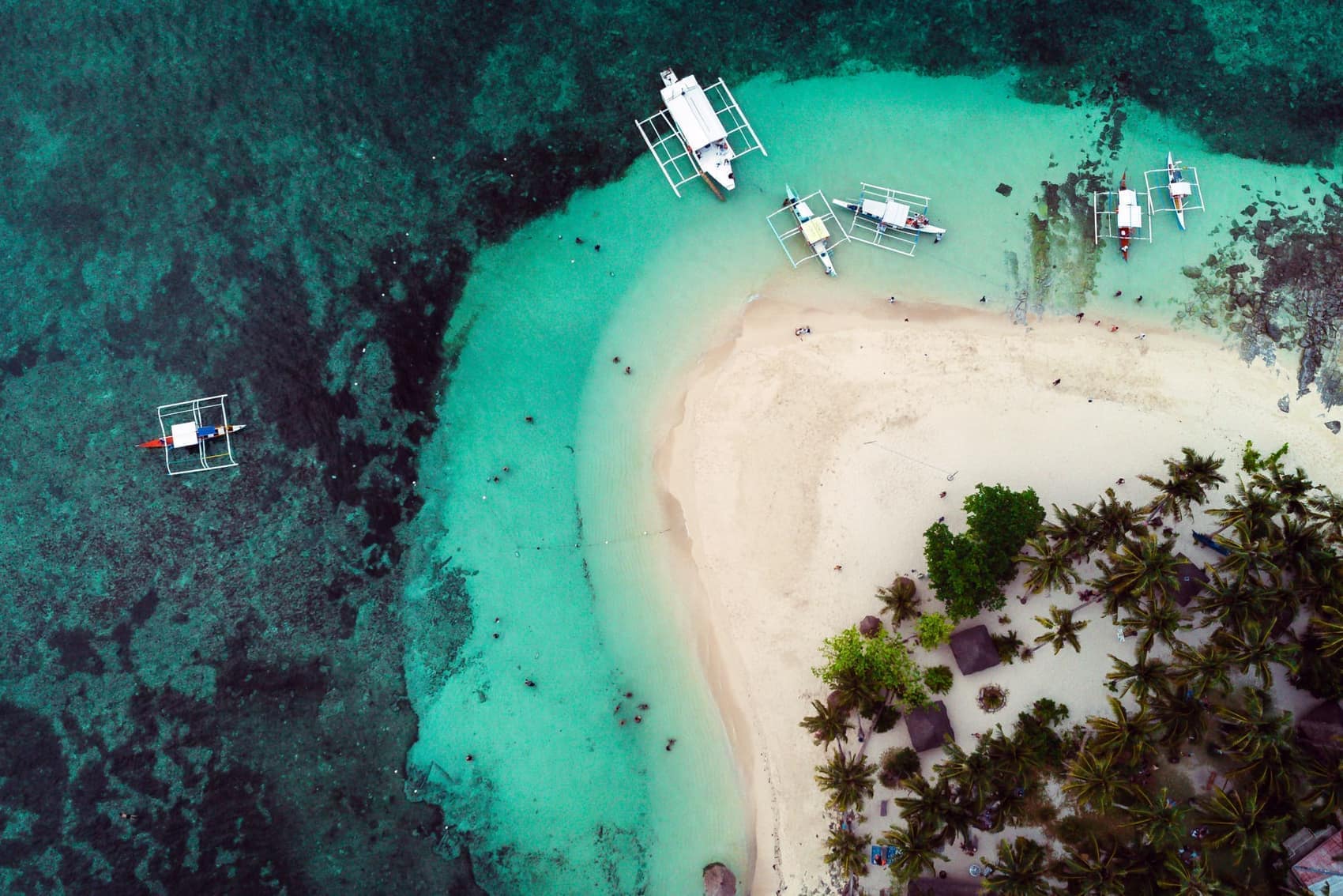
Every morning the outriggers line up along the General Luna boardwalk, bamboo arms nudging each other in the shallows, and by nine they're strung out across the Pacific in a loose convoy. The route is a triangle of absurd contrasts: a bare 200-metre spit of sand with no shade at all, a proper island village where somebody's aunt grills your prawns over coconut husk, and a knot of palm trees so small you can circle it in four minutes. No crossing is longer than forty minutes, and the water between them runs from milk-glass shallows to that hard reef-blue you only get over deep coral.

You register at the General Luna tourism desk beside the boardwalk, pay your fees, get assigned a bangka and a boatman, and go: there are no fixed departures, and boats leave as groups arrive, generally between 8:00 and 10:00am. Most crews run Naked first (the sandbar is at its widest on a falling tide and the light is cleanest before noon), then Daku for a long lunch stop, then Guyam on the way home; ask to reverse it if you want Naked in golden hour, which is the better photograph but the busier beach. Crossings are short, roughly 20 to 30 minutes out to the first island and 20 to 30 between each, so the day is mostly beach, not boat. Lunch happens on Daku: you either bring a cooler from the General Luna market, or buy seafood by the kilo from the island families and pay a small cooking charge to have it grilled over coals and laid out boodle-fight style on banana leaves with rice, mango, watermelon and seaweed salad. Bring everything in cash; there is not an ATM or a card terminal on any of the three islands. Boats generally have to be off the water by 5:00pm, so a full day runs about six to eight hours door to door.

Duration: 6–8 hours (roughly 09:00–16:00)
Private boat: PHP 3,000–9,000 depending on group size
Joiner tour: PHP 1,500–1,600 per person
LGU tourism fee: PHP 100 per person (PHP 80 senior/PWD, free under 10)
Docking: PHP 50 Guyam + PHP 100 Daku, per boat
Lunch: PHP 200–400 pp, or seafood ~PHP 500–600/kg + cooking charge
Hut/cabana rental on Daku: ~PHP 300
Bring: PHP 2,000–3,000 cash, reef-safe sunscreen, hat, rash guard, umbrella, dry bag, water, towel
Difficulty: easy, swimming and wading only
Boats must be off the water by ~17:00
  • Departs from the General Luna port / boardwalk: the tourism office assigns and registers every boat
  • Official 2025–26 boat rates run roughly PHP 3,000 (up to 5 pax) to PHP 9,000 (21–24 pax), guide included
  • Joiner/shared tours are PHP 1,500–1,600 per person including van transfers, lunch and fees
  • Fees on top of the boat: PHP 100 per person LGU tourism fee, plus PHP 50 (Guyam) and PHP 100 (Daku) docking per boat
  • Lunch is grilled on Daku by island families: boodle fight on banana leaves, or seafood by the kilo
  • Cash only, everywhere. No ATMs, no card machines, no shops on Naked or Guyam
Operator & booking info

3 stops · tap to open

02Nov 25 · Bucas Grande

Sohoton Cove

The best day trip from Siargao, and the longest. Read the November warning first.

Bucas Grande is a separate island world south of Siargao, a drowned limestone labyrinth of jade water, jungle-topped karst and hidden lagoons in the municipality of Socorro, Surigao del Norte. You get there on an outrigger bangka out of Dapa port, across open water, and the cove itself only opens to you when the tide falls far enough to expose a low rock arch you physically duck under. Inside are the stingless jellyfish lagoon, a pitch-dark cave you swim into, and a cave you crawl through and then jump out of. It is one of the best days in the Philippines, with two large caveats: it eats an entire day, and the jellyfish are seasonal.

Plan a 10–12 hour door-to-door day. Hotel pickup in General Luna is typically 6:30–7:45am, then 35–45 minutes by van to Dapa port on Siargao's south coast. The crossing to the Sohoton Tourism Center on Bucas Grande takes roughly 1.5–2 hours out and up to 2.5 hours back if the seas are up. Bloggers who timed it logged exactly 2 hours out and 2.5 hours home. At the tourism center you register, put on a life jacket and helmet, and transfer from the big diesel bangka into small paddle boats. From there a boatman poles you under a low limestone arch (the only way in or out of the cove) with stalactites close enough to touch. That arch is why the whole day runs on the tide. At high tide it's submerged and the cove is closed, and at the wrong tide individual caves are off-limits. Operators build the departure time around the tide table, so you don't get to pick your favourite start time. Inside the cove you do Hagukan Cave, Magkukuob Cave (with its cliff-jump exit), and Tojoman Lagoon, the jellyfish sanctuary, with a boodle-fight lunch in the middle. You're usually back on Siargao between 4pm and 6pm, salt-crusted and wrecked.

Duration: full day, ~10–12 hours (pickup 6:30–7:45am, return 4–6pm)
Boat time: ~1.5–2 hrs each way from Dapa port; up to 2.5 hrs returning in rough seas
Joiner tour: PHP 2,300–3,100 per person (2026); PHP 3,000–3,100 is typical from General Luna operators
Private boat: PHP 7,500–11,000 for up to ~10 people; DIY boat rental PHP 4,000–5,000 plus per-head fees
Consolidated eco-tourism / entrance fee: ~PHP 800 per person (usually included in joiner packages)
Itemised fees if going DIY: Sohoton entrance ~PHP 100, environmental fee ~PHP 25, paddle boat PHP 150–200, guide PHP 100–150 per group
Jellyfish season: peak March–June/July; sparse or absent November–February
Bring: reef shoes or Crocs, dry bag, towel, waterproof phone case, cash (no ATMs), earplugs for the diesel engine
Do NOT wear sunscreen or lotion in the jellyfish lagoon: it's banned to protect the jellies
Tide-dependent: the operator sets departure around the tide table, not around you
Seasickness tablets are a good idea for a November crossing
  • The brown-spotted stingless jellyfish peak roughly March to July and are broadly around from March to October. November to February is the lean window, and operators say plainly you may see a few or none
  • Our late-November dates fall in that lean window, so budget for no jellyfish and treat any we see as a bonus. Moon jellies sometimes linger year-round, but they carry a mild sting and are not the headline act
  • November is also the start of the amihan (northeast monsoon): Dinagat Sound gets choppy, and rough-sea or Coast Guard advisories can cancel the crossing outright. Build a spare day into the itinerary
  • It is a long day: roughly 2–2.5 hours by boat each way from Dapa, plus the drive to the port. Realistically 10–12 hours from hotel pickup to hotel drop-off
  • Entry to the cove is tide-gated. You transfer to a paddle boat and physically duck under a low limestone arch; at high tide the entrance is underwater and the cove is shut
  • Even without jellyfish the cove, the caves, the cliff jump and the karst scenery hold up, so it is worth going for the cove and the caves rather than the jellyfish
Operator & booking info

6 stops · tap to open

03Nov 26 · Tide-dependent

Land tour & Sugba

One island, two coasts, and a tide chart you plan the day around

You cross Siargao twice today: east to Pilar, where the Pacific pulls back off a shelf of volcanic rock and leaves behind turquoise swimming pools that did not exist an hour earlier, then west to Del Carmen, where a wooden banca threads 30 minutes of mangrove channel and opens into a jade-green lagoon ringed by limestone. Somewhere between the two coasts the surf town turns into an island. In between: a road so straight and so buried in coconut palms it looks computer-generated, an emerald river you drift down on a bamboo raft, and Siargao's only waterfall. You let the tide decide the running order, not your alarm clock.

The hard constraint is Magpupungko. The rock pools are a tidal feature, and they only exist as pools for roughly two hours either side of low water. At high tide the guards turn you away, because there is nothing to see and it is unsafe. So the first thing you do when planning this day is pull the Siargao tide chart for your date, find the low-tide time, and build backwards. If low tide falls in the morning, roughly 6-10am, you run the loop clockwise. Magpupungko first at dawn, then Taktak Falls, then Coconut Road and Maasin River on the way back, finishing with sunset at Cloud 9. If low tide falls in the afternoon, roughly 1-4pm, you flip it. Sugba Lagoon first thing, since boats from Del Carmen start at 8am and you want to be at the diving board before the crowds, then back across the island for the palm-tree stops, and Magpupungko in the afternoon window. Doing Magpupungko and Sugba on the same calendar day is ambitious but doable. They sit on opposite coasts, about 1hr 45min apart by road, and most people who try it end up rushing one of them. Split them across two days if you can. If you cannot, let the tide pick which one gets the good light. Transport is the other decision. A habal-habal, a motorbike taxi with a driver who knows the stops, runs about PHP 1,500 for the full day and is the most fun. A private van or multicab with driver runs roughly PHP 3,500-5,000 for the day and is the sane choice for a family, luggage, or rain. Organised group land tours run about PHP 1,500-2,500 per person including entrances and lunch, and private packaged tours run to roughly USD 90 per person. Bring far more small-denomination cash than you think you need. Every single stop collects a fee at a plastic table, nowhere takes cards, and there are no ATMs outside General Luna and Dapa.

Duration: 8-9 hours door to door
Habal-habal with driver: PHP 1,500/day
Private van or multicab with driver: PHP 3,500-5,000/day
Joined group land tour: PHP 1,500-2,500 per person
Private packaged land tour: ~USD 90 per person
Total entrance fees: PHP 400-600 per person
Bring: reef shoes, dry bag, reef-safe sunscreen, PHP small bills
Difficulty: easy, but long hours on rough road
  • Magpupungko's pools are visible and swimmable only ~2 hours either side of low tide: check the chart before anything else
  • Sugba Lagoon needs a drive to Del Carmen port plus a 20-30 min banca ride; boats run roughly 7am-5pm, first departure 8am
  • The two headline stops are on opposite coasts, ~1hr 45min apart, and you let the tide decide which one gets priority
  • Total loop is 8-9 hours and about 120km of Siargao Circumferential Road
  • Every stop is cash-only, PHP, small bills: budget PHP 400-600 per person in fees alone
  • The famous bent palm at Maasin River fell in February 2023; a jump tower stands in its place
Operator & booking info

7 stops · tap to open

Logistics

Getting around

Habal-habal, tricycle or scooter: for a family in November, hire the van

There is no Grab and no Uber on Siargao. Transport is a motorcycle taxi (habal-habal) for one or two people, a motorcycle-with-sidecar tricycle for short town hops, a rented scooter if you want total freedom, or a van with a driver if you want the whole family, the boards, the bags and the rain handled at once. Everything is negotiable and everything is cheap by Western standards; the real currency is time and comfort, because distances that look tiny on a map take 45 minutes on Siargao roads.

Short hops inside General Luna are tricycle territory: PHP 20-30 per person in daylight, around PHP 50 at night, and PHP 30-50 for the run out to Cloud 9. Habal-habal (you on the back of a local's motorbike) costs roughly PHP 50-100 for 5-10 km, PHP 100-200 for 10-30 km, and PHP 200-400 for anything longer; Del Carmen to General Luna runs about PHP 300-400 per person. Scooter rental is PHP 350-600 a day, or PHP 3,000-3,500 for a week, with fuel at PHP 52-72 a litre and 45-55 km to the litre, so a full day of touring costs almost nothing in petrol. Read the fine print before renting: a foreign licence is generally accepted for up to 90 days from arrival, an International Driving Permit is worth carrying, riding without a valid licence carries a PHP 3,000 fine, helmets are legally required, and checkpoints in Dapa and General Luna do stop people. A van with a driver is PHP 2,500-4,000 for a full day (typically 8-10 hours and up to 200 km, driver and fuel included) or PHP 500-800 an hour with a four-hour minimum. Airport transfers from Sayak: shared van PHP 300-400 per person, private van PHP 2,000-2,500 for the whole vehicle, resort-arranged transfer PHP 800-1,200, tricycle PHP 500-800 if you are travelling light. A van and driver for most of the stay is worth it for a family, though not for every single day. Book a private van both ways for the airport (non-negotiable with luggage and kids after a two-flight day), add a van and driver for the two or three big touring days (Coconut Road and the palm viewpoint, Magpupungko timed to low tide, Del Carmen's mangroves and Sugba Lagoon), and use tricycles for the short General Luna hops in between, which are cheap, fun and take two minutes to flag down. Booking a van for idle beach days is money burnt. The case for the van gets stronger in November: main roads are paved but the east coast has rough patches, there are no street lights, so night riding is dangerous, stray dogs cause a real share of accidents, locals advise not exceeding 40 kph, and a warm tropical downpour that is an adventure on a scooter with one adult is a miserable hour with children. Find a driver you like on day one. Most will take half- or full-day hires for the rest of the trip, and a good one becomes your tide-table advisor, restaurant fixer and weather forecaster.

Sayak airport to General Luna: private van PHP 2,000-2,500; shared van PHP 300-400 per person; 45-60 minutesForeign licence generally valid 90 days from arrival; IDP recommended; riding unlicensed = PHP 3,000 fineHelmets required by law; checkpoints in Dapa and General LunaAgree the fare before you get in: nothing is meteredNo street lights: avoid riding after dark, and watch for stray dogs; keep to about 40 kphNovember rain makes scooter days with kids a bad bet, so budget for the van instead
01

No Grab or Uber: habal-habal, tricycle, scooter or private van only

02

Tricycle in General Luna: PHP 20-30 per person by day, about PHP 50 at night; PHP 30-50 out to Cloud 9

03

Habal-habal: PHP 50-100 short, PHP 100-200 medium, PHP 200-400 long; Del Carmen to General Luna PHP 300-400

04

Scooter: PHP 350-600 a day or PHP 3,000-3,500 a week; fuel PHP 52-72/litre at 45-55 km/litre

05

Van with driver: PHP 2,500-4,000 per day (8-10 hrs, ~200 km, driver and fuel in) or PHP 500-800/hour, 4-hour minimum

06

For a family: private van for both airport runs and the 2-3 big touring days, tricycles for everything local

Dinner

Where we eat

General Luna punches absurdly above its weight. Five places worth planning around — two of which genuinely need a reservation.

An Italian-imported brick oven sits at the heart of a nipa-roofed dining room where a live coconut palm grows straight through the floorboards. Conde Nast Traveler called it possibly the best pizza and fresh-made pasta in the Philippines, and two decades on the queue still proves the point. Kids sprawl on the cushioned platform benches while the dough gets slapped out three metres away. It is loud and barefoot, with sand on the floor and no pretension anywhere: the surf-town institution that happens to make a serious Parma ham pizza. Kermit runs all day from 7am, but the brick oven only fires from 11am to 10pm, so pizza is a lunch-or-dinner decision. Order the Kermit Pizza (provolone, mozzarella, gorgonzola, parmesan and Parma ham) and the Truffle Pizza for the table, then add Pappardelle al Antonio (fresh handmade ribbons with shrimp, tomato, garlic and a hint of chilli) for whoever wants pasta. The kitchen splits its day into service windows: breakfast 7-10am, lunch 11am-2pm, light bites and sandwiches 2-5pm, dinner 5-10pm, with happy hour 4-8pm daily and all night on Fridays. The green-tiled bar with sand underfoot is a nice place to park with a cold one while the kids demolish a Margherita. Booking matters here: this is the single most oversubscribed table in General Luna and walk-ins at 7pm in dry season routinely get turned away.

Order this

Named by Conde Nast Traveler as possibly the country's best pizza and fresh pastaOpen-air dining room built around a living coconut palm; sand floor at the barHappy hour 4-8pm daily, all night FridayPasta is handmade in-house: pappardelle, linguine, lasagnaAlso a surf resort, so the crowd is a mix of guests and the whole island
Find it

Watch

Siargao, on film